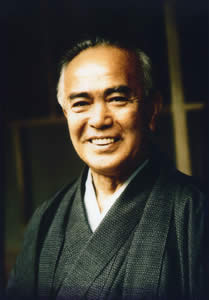
Koichi Tohei (Tohei Koichi藤平光一) (20 January 1920 – 19 May 2011) was an important figure in the Post-War period of Aikido. In 1971 founded the Ki Society (originally named Ki no Kenkyukai, Lit. “Ki Research Society”, but usually translated as just “Ki Society”) to teach Ki Development and Ki Principles) and later, in 1974, the Ki Society style of Aikido, officially Shinshin Toitsu Aikido (literally “Aikido with Mind and Body Unified”), which is commonly known outside Japan as Ki-Aikido.
Tohei Shoushu (Leader of the School/Style) was born in Tokyo in 1920. During his childhood, the family returned to the family’s hometown in the Tochigi Prefecture, where he grew up. As a young man he studied Judo, and trained with the Ichikukai organization, learning a breathing method, Misogi “purification” rituals, and Zen. In 1939, at the age of 19, he started study with the Founder of Aikido, Morihei Ueshiba (universally known in Aikido circles as O-Sensei (Great Teacher)).
Tohei’s studies were interrupted when he was drafted into the army as The Great Pacific War (WWII) was coming to a close. After the war ended and he returned to Japan, he resumed study with the Ichikukai, and with O-Sensei in Aikido. He also started study with Tempu Nakamura Sensei, known as the founder of Yoga in Japan.
Nakamura Sensei, an accomplished Martial Artist and intellectual, who studied both traditional and Western medicine and learned Yoga in India, used his knowledge of these arts to develop a system of explicitly training and developing Ki (Life energy/vitality) principles and awareness. Prior to this, it was commonly accepted in Japan and China that “Ki” could not be taught, only “caught” by close association with someone who had mastered it. His major insights can be summed up in the phrases “the Mind moves the Body” and “Mind and Body are One” – this Mind/Bady Oneness is the essence of what we call “Ki”. Nakamura’s system eventually became known as Shin-Shin-Toitsu-Do (Way of Mind and Body Unification: Toitsu can be translated as Unity/Unification, Coordination, or Oneness). There is still an organization in Japan – the Tempu-kai – which teaches his system.
In the years immediately after the war, as Japan recovered economically and culturally, Tohei quickly became a top Aikido teacher and organizational leader at the Aikiaki Hombu, the headquarters dojo of Aikido in Tokyo. In 1952 he was appointed by O-Sensei to the Aikido 8th Dan, at the time the highest Aikido rank.
In 1953 he was chosen to travel to Hawaii to introduce Aikido as the first official representative of Aikikai to teach outside Japan. He stayed in Hawaii one year, and returned for extended visits in 1955 and again in 1959. In 1956 he was formally appointed Chief Instructor (Shihan Bucho) and Instructor of Instructors (Shihan no Shihan) of the Aikikai international organization.
Between 1953 and 1971 he completed at least 15 international trips promoting Aikido – to Hawaii, the mainland USA, and other locations; he also wrote several books (published in Japanese and English), and participated is some films introducing Aikido to wider audiences in Japan and around the world.
In 1960 O-Sensei and the Aikikai created the rank of 9th Dan, and Tohei was the first person formally appointed to that rank. In January 1969 O-Sensei created the rank of 10th Dan and appointed Tohei as the first to hold that rank; he wrote Tohei a certificate.
O-Sensei died in May of 1969. Upon O-Sensei’s death, his son Kisshomaru Ueshiba became the Doshu (Head of the Style) and Tohei continued as Chief Instructor. In 1970, after a suitable mourning period, the Aikikai Hombu Dojo Board confirmed the 10th Dan ranking. This is still the highest rank in Aikido; only a few other senior instructors have since been awarded 10th Dan by the Aikikai, often posthumously.
In his teaching – at Aikikai Hombu and internationally – particularly after being appointed Chief Instructor, Tohei Sensei was more and more incorporating the Ki training principles he was learning from Nakamura Sensei into his teaching of Aikido. This did not sit well with Kisshomaru or some other of the senior Aikikai instructors. This caused much friction, both within the Hombu and internationally, so in 1971 Tohei Sensei organized a separate organization, the Ki no Kenkyukai, to teach Ki Development and Principles outside the Aikikai, not using Aikikai space or funds. It was during this time Tohei Sensei first developed criteria for Ki Development and started issuing Ki Rankings, a unique hallmark of Ki Society.
Unfortunately, the friction continued, and in 1974 Tohei Sensei resigned from the Aikikai organization completely, and started teaching his own approach to Aikido; he named his style of Aikido Shinshin Toitsu Aikido – Aikido with Mind and Body Coordinated. (Alternatively, “Toitsu” can be translated as “Unified” or “Oneness”.)
The Ki Society grew quickly after this, both in Japan and overseas, where Tohei Sensei had supported Aikido’s growth and development and was widely recognized as the face of Aikido. Tohei Sensei continued to travel extensively to promote the principles of Ki and Ki-Aikido.
Especially after the establishment of Ki Society, Tohei Sensei was long famous for teaching Ki to many well-known athletes, including Sadaharu Oh and his one-legged batting stance, as well as taking care of the Sumo rikishi (and later Yokozuna) Chiyonofuji’s dislocated shoulder.
Furthermore, Ki Society International is the only facility specializing in the study of Ki in Japan, having been approved by the Ministry of Health and Welfare in 1977. In order to expand understanding of Ki, he opened the Ki Health Institute and created an “at-home” course in which students become Ki Health graduates in their own homes. <This passage is about things which are no longer active: the Ministry of Health approval was dropped in the 2000’s when the Ki Society was reorganized; I believe the Ki Health Institute is no longer in operation.
During his career Tohei Sensei authored several books about Aikido, Ki-Aikido, and Ki; current books in Japan include Ki no Iryoku (“Power of Ki”), Seiko no Hiketsu wa Ki ni ari (“The Key to Success is Ki”) and countless others.
Koichi Tohei Sensei gradually “retired” in the 1990’s, and his son, Shinichi Tohei Sensei took on more administrative duties. He did continue teaching some classes, particularly for World Camp sessions at the HQ in Tochigi; these classes were for international students. His last overseas teaching trip was to Portland, Oregon in 1997. He was scheduled to teach on Maui in 2001 but his health prevented his travel and Shinichi Tohei Sensei first taught a big international seminar in his stead.
In 2007, under the guidance of Shinichi Tohei Sensei as Kaicho (President), the Ki no Kenkyukai organization was legally reorganized as Shinshin Toitsu Aikido Kai, but is still known informally as Ki Society.
Koichi Tohei Sensei died, 19 May 2011, aged 91.

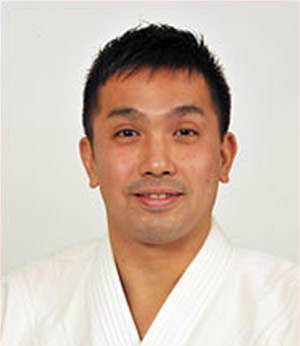 Shinichi Tohei Sensei was born in 1973. He graduated from Tokyo Institute of Technology, school of Bioscience and Biotechnology.
Shinichi Tohei Sensei has been learning Ki Principles through Shinshin Toitsu Aikido (Ki-Aikido) from Master Koichi Tohei, Aikido 10th dan and Shinshin Toitsu Aikido Founder, since childhood.
Now, as successor to Master Koichi Tohei, he teaches Shinshin Toitsu Aikido in Japan and throughout the world. By using Ki principles in the development of human resources and communication skills, he also teaches business personnel, executives, and educators at seminars and workshops.
Recently he accepted an offer from a Major League Baseball team, the Los Angeles Dodgers, to teach Ki Principles to their players. He has been teaching Ki Principles in special training camps to further the players’ development since January 2010.
He is the master teacher of Keio University Shinshin Toitsu Aikido club. Also, he teaches Shinshin Toitsu Aikido in general education at Keio University as a part-time instructor.
Shinichi Tohei is the President (Kaichou) and Chief Instructor of Shinshin Toitsu Aikidokai and Ki Society HQ.
More than 50,000 people study Shinshin Toitsu Aikido in the world. We all walk the same road in overcoming the differences of languages, cultures and religions.
Shinichi Tohei Sensei was born in 1973. He graduated from Tokyo Institute of Technology, school of Bioscience and Biotechnology.
Shinichi Tohei Sensei has been learning Ki Principles through Shinshin Toitsu Aikido (Ki-Aikido) from Master Koichi Tohei, Aikido 10th dan and Shinshin Toitsu Aikido Founder, since childhood.
Now, as successor to Master Koichi Tohei, he teaches Shinshin Toitsu Aikido in Japan and throughout the world. By using Ki principles in the development of human resources and communication skills, he also teaches business personnel, executives, and educators at seminars and workshops.
Recently he accepted an offer from a Major League Baseball team, the Los Angeles Dodgers, to teach Ki Principles to their players. He has been teaching Ki Principles in special training camps to further the players’ development since January 2010.
He is the master teacher of Keio University Shinshin Toitsu Aikido club. Also, he teaches Shinshin Toitsu Aikido in general education at Keio University as a part-time instructor.
Shinichi Tohei is the President (Kaichou) and Chief Instructor of Shinshin Toitsu Aikidokai and Ki Society HQ.
More than 50,000 people study Shinshin Toitsu Aikido in the world. We all walk the same road in overcoming the differences of languages, cultures and religions.